Homemade sausage and large pizza
Overview
I haven’t uploaded a recipe for many years. I accidentally clicked on the login page today and found that the recipe I had saved photos of for 17 years was still there, so I improved the text and uploaded it. From 17 to 22, four years passed so suddenly. During this period, too much happened and I experienced a lot, but this unfinished recipe is still there. No matter when, food can always soothe our souls and warm our lives. For those of us who love to eat, we hope this recipe can give you some help and warmth. These photos were all taken in 2017, so the method was what I used at that time. Now my method has changed, and so has my taste. I will upload new recipes when I have the opportunity.
Tags
Ingredients
Steps
-
For the dough, you need flour (anything except low-gluten flour is acceptable, I used ordinary all-purpose flour here), warm water (just put your hand in it and it feels warm), yeast, salt, and vegetable oil (I used olive oil).

-
Add yeast to warm water and stir to combine.

-
After stirring the yeast, add flour, mix until there is no dry powder, and then start kneading it into a dough.

-
Add less salt to the dough to strengthen the dough and add some flavor to the crust.

-
Add vegetable oil.

-
Knead hard to get the oil into the dough, you can also scratch it, it doesn't matter the method, as long as the goal is achieved.

-
Knead.

-
Knead.

-
Knead.

-
Knead.

-
Knead.

-
Use the dough to absorb all the oil on the back of your hands, and knead the dough slightly as usual.

-
That's probably it.

-
Cover the dough with plastic wrap and place in a warm place to ferment. After fermentation is successful, knead it twice using the normal dough kneading method. After deflating, continue to cover with plastic wrap and ferment.

-
A lid was added to keep it warm.

-
The following is a successful fermentation: after you see that it has puffed up and is about twice as big as before, you can poke a hole with your fingers and it will not rebound.

-
Stuffing: onions, tomatoes, sausages, black olive slices, cracked black pepper, olive oil, grated cheese, tomato sauce, salt.

-
Cut the sausage into small pieces.

-
Slice tomatoes, not too thick.

-
Cut the onion into shreds and squeeze it with your hands until the juice is squeezed out before adding it in.

-
The sausages are at the bottom, and then the tomatoes and onions are placed anywhere.

-
Add salt.

-
Add cracked black pepper.

-
Add black olive slices, mix well and then add vegetable oil and mix well. Wrap in plastic wrap and refrigerate.

-
Knead the dough after the second deflation.

-
Grease a baking sheet (or line it with baking paper). The baked dough after applying oil will be crispier and have more oil.

-
Apply oil.

-
Not just the bottom, but also the four walls.

-
Spread the dough flat on the baking sheet with your palms. It is more convenient to press it with your palms. You can rotate the baking sheet in conjunction with it. Be sure to spread the dough as flat as possible.

-
Spread it out.

-
Spread it out.

-
The four walls must be upright, otherwise the juice flowing out will burn the back of the crust.

-
Use your finger knuckles to press the connection between the four walls and the bottom of the plate to make a small groove. The crust will not break, but will become thinner.

-
To apply tomato paste, you can apply it with your hands, a spoon or a brush.

-
Place in the oven, close the door and ferment for 20-30 minutes. The oven isn't on here.

-
Take out the baking pan, close the oven, set the temperature to 220 degrees, and turn on the heat. Sprinkle some grated cheese on the crust.

-
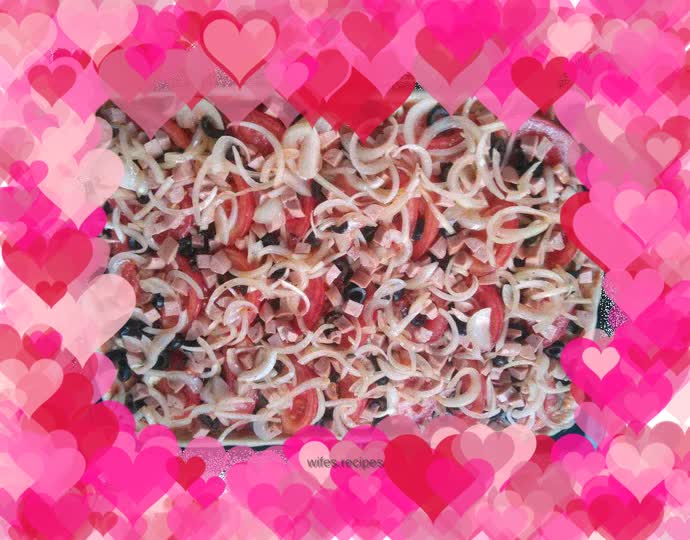
Place the marinated fillings on the pie crust in this order: tomatoes - sausage, black olive slices - onion shreds. Be careful to pinch the onion shreds to remove as much water as possible.

-
Plating.

-
Bake in the oven at 220 degrees for about 35 minutes, take it out, sprinkle with the remaining shredded cheese, and bake for another 5 minutes. Take it out of the oven when all the cheese has melted and part of it has turned brown.
