Good Luck (Less Oil Braised Lion Head)
Overview
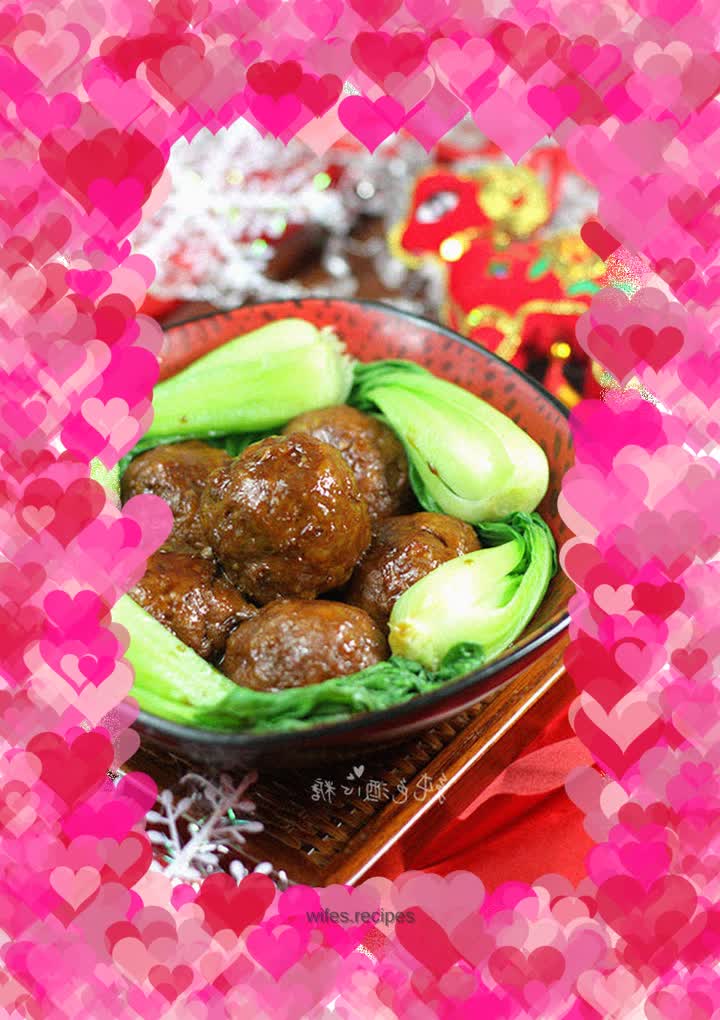
This is a typical southern dish. Because it has a good meaning, it is a delicious dish that is often served on the New Year’s and festival tables. This dish has been around for a long time, and many of the dishes that have been handed down have their own stories. For example, the story of Kung Pao Chicken that I first heard came from Du Niang. It talks about the legendary lion head, which in Yangzhou dialect means big meatballs. In northern dialect, it is called big meatballs or Sixi meatballs. It is said that its distant ancestor is Tiao Wan Zhi recorded in the "Shi Jing" of the Southern and Northern Dynasties. When Emperor Yang of the Sui Dynasty traveled south along the Grand Canal, he was very nostalgic for the four famous scenic spots in Yangzhou: Wansong Mountain, Qianqian Dun, Ivory Forest and Sunflower Hill. After returning to the palace, he ordered the imperial chef to prepare dishes based on these four scenes, so he ordered four dishes: squirrel mandarin fish, money shrimp cakes, elephant bud chicken strips and sunflower chopped meat. In the Tang Dynasty, Wei Zhi, the Duke of Xi State, saw that when the dish of sunflower chopped meat was served, the sunflower heart made of huge meat dumplings was exquisite, like the head of a lion. So the sunflower chopped meat was renamed "lion head". As soon as Bainuo was called, the famous dish of lion head was added to Yangzhou from then on. So I learned that the birthplace of this southern dish is Yangzhou, and the version of lion head I made today is slightly different from Yangzhou lion head. It contains glutinous rice and water chestnuts, which I like. I like the soft glutinous rice and water chestnuts. The small particles have a crunchy texture. Some places also add eggs when making lion heads. When I tried making it, I used deep-frying according to the original recipe. As a beauty lover, I really can't stand a lot of oil in the pot, let alone the food. After putting it in the pot, I decided to change the method to make the lion head. In fact, the purpose of deep-frying is to use high oil temperature to shape the lion head. I moved the lion head to the oven and used high temperature to set the shape. At the same time, some of the fat in the pork will leak out. Although the leaked fat will flow into the soup in the last step, which is more delicious, my lion head is undoubtedly the least harmful to people. There are too many people with high fat!
Tags
Ingredients
Steps
-
Soak the glutinous rice one night in advance, steam it for about 10 minutes the next day, filter out the water and let it dry;

-
Chop the water chestnuts into pieces;

-
Wash the rapeseed;

-
Use a knife to chop the meat into minced meat. I choose fat 2 and lean 8, depending on preference;

-
Chop the onion and ginger into fine pieces and prepare the star anise;

-
Chop the meat filling into minced meat, put it into a basin, add minced water chestnuts, steamed and dried glutinous rice, rice wine, chopped onion and ginger, white sugar, 15ml of light soy sauce, 5ml of dark soy sauce, and 3g of white pepper. Stir together, dip your hands in water, shape into a round shape with your hands and set aside;

-
Preheat the oven to 210 degrees. Place tin foil on the baking sheet and brush it with oil. Place the meatballs on the baking sheet and shape them into a shape that is larger at the top and slightly smaller at the bottom. In this way, the meatballs will collapse over time as they bake, making the surface more round and beautiful. Bake for 20 minutes;

-
Put a small amount of oil in the wok, when it is hot, add a star anise and fry until fragrant, then add the lion head;

-
Add 500ml of hot water, 15ml of light soy sauce, and 25ml of dark soy sauce, bring to a boil over high heat, then reduce to low heat, add rock sugar, cover and simmer for 30 minutes;

-
Open the lid, add salt, turn to high heat to reduce the juice, add the rapeseed, and the remaining small amount of soup is ready to be served. ;
