Grapefruit Chiffon
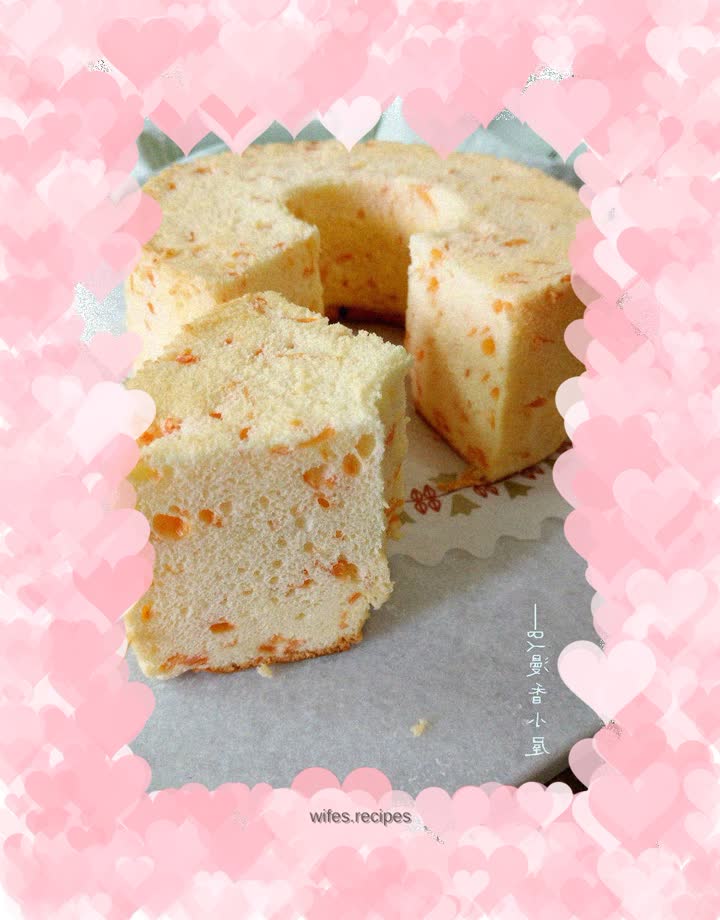
Overview
This is a chiffon that has been growing for a long time. I personally like it after eating it. There are two things that impressed me about the preparation process: First, the original recipe said to break the pulp into pieces and take out the dripping juice. However, I broke all the pulp into pieces, and there was not a drop of juice underneath! ! ! Well, the recipe is dead, but the person is alive, so I squeezed the pulp and the juice came out, ha~~~~. Second, the egg yolk batter is actually a bit dry. I thought it would be a failure. When I added 1/3 of the meringue, I used an egg beater to pull it up from the bottom, but after mixing it, it felt okay. After all the meringue was mixed in, the batter did not feel particularly dry. However, it may be difficult for novices to mix it, and it may defoaming due to uneven mixing and mixing for a long time. (I made two eggs by halving them. The mold was a 15CM hollow mold. The original recipe was for 4 eggs and I used a 17CM hollow mold.) Compared with making chiffon in a regular mold, the hollow mold is hollow in the middle, which increases the heating area. The problem of undercooking and denting in the middle that novices are most afraid of can be reduced. Of course, it needs to be baked for enough time. The last thing I want to say is that the taste is a bit bitter, slightly bitter, slightly bitter~~~Don’t try it if you don’t like it! !
Tags
Ingredients
Steps
-
Peel the flesh out of the grapefruit and squeeze out 25 grams of juice with a spoon or other tools. I took 55 grams of pulp. In fact, it is a little more, but it can also be a little less.

-
Add fine sugar to the egg yolks and mix until saccharified. Add corn oil and grapefruit juice and mix well.

-
Sift in the flour.

-
Use a whisk to mix the batter in a Z-shape, add the grapefruit meat and mix well.

-
The batter at this point is relatively dry. At this point preheat the oven to 190 degrees.

-
The container containing the egg whites should be oil-free and water-free. Add a few drops of lemon juice to the egg whites and beat at low speed to make a rough foam. Add the fine sugar in three batches and beat until it becomes dry peaks with a little hook.

-
Take 1/3 of the egg white and add it to the egg yolk paste. Use an egg beater to scoop it up from bottom to top, shake it a few times, scoop it out again, and mix well.

-
Pour in the remaining 2/3 of the egg whites.

-
Use a spatula to stir evenly from bottom to top, use one hand to mix and the other to turn the plate, light and fast.

-
Pour the mixed batter into the mold, smooth it out, and shake it on the table a few times to remove any big bubbles.

-
Place in the middle and lower racks of the oven and turn to 170-175 degrees for about 33-35 minutes. The specific temperature and time should be adjusted according to your own oven.

-
Immediately after baking, take out the cake and turn it upside down. Because I am not satisfied, I can turn it upside down directly. If the cake comes out of the mold too much, I can also turn it upside down on the bottle and unmold it after it cools down. Because there is too much pulp inside, it will be unmoulded and it will be broken.

-
Finished product

-
Finished product

-
Finished product
