Coconut puff pastry
Overview
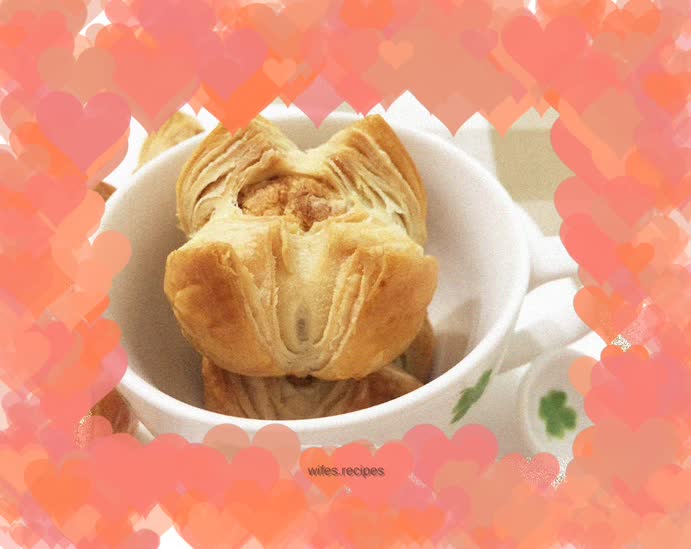
A crisp that blooms like a flower. In the words of my friends, it is both beautiful and delicious inside and out. The coconut milk is so fragrant, my mother said, it is so delicious, but the calories are too high... while putting it in her mouth. Reference serving size: 15 pieces.
Tags
Ingredients
Steps
-
First make the water-oil dough. Pour 150g of all-purpose flour, 50g of lard, and 15g of sugar into a bowl.

-
Pour 80-degree hot water into a bowl (almost boiling enough to shake a few times in the cup), and stir quickly to combine the flour and water into a snowflake shape. Please add the amount of water as appropriate according to the state of the dough. (Using hot water can partially mature the flour, making the dough softer and easier to work with)

-
Pour the flour lumps onto the chopping board and knead vigorously into a smooth dough. Oily skin needs more kneading before it can withstand various tossing later on. Cover the kneaded dough with a damp cloth or plastic wrap and set aside.

-
Next make the puff pastry. Mix 130g of low-gluten flour and 65g of lard.

-
Pour onto a chopping board and knead until the lard and flour are completely combined into a dough. It will be dry and loose at first and not form a ball. Just keep kneading and don't add water.

-
Knead into smooth pastry dough and set aside.

-
Let the water-oil skin and puff pastry dough rest for 20 minutes to relax. Remember to cover watery and oily skin with a damp cloth or plastic wrap. The pastry does not need to be covered and can be left open.

-
While the dough is resting, make the coconut filling. Put 30g butter in a bowl and melt over water.

-
Pour all other coconut filling ingredients (60g coconut, 25g egg liquid, 35g sugar powder, 20g milk powder, 15g dried cranberries) into the melted butter.

-
Stir into coarse grits and place in the refrigerator to harden.

-
Divide the relaxed water-oil skin and puff pastry dough into 15 portions, roll into balls and set aside. During the process of dividing the water-oil skin, always remember to cover it with a damp cloth or plastic wrap.

-
Take a piece of water-oil dough, flatten it and roll it into a round piece. Place a piece of puff pastry in the middle.

-
Wrap the pastry with water-oil dough and pinch tightly. Press flat.

-
Use a rolling pin to roll it into a shape of beef tongue. Be gentle when rolling. (Apply some oil on the rolling pin to prevent the oil skin from peeling off)

-
Roll up the ox tongue-shaped dough from top to bottom.

-
Turn the rolled dough 90 degrees to become vertical and press flat.

-
Use the rolling pin to roll it into a long strip again, thinner and longer than the first time.

-
Roll it up again from top to bottom.

-
After everything is rolled, cover the dough with a damp cloth or plastic wrap and let it rest for 15 minutes.

-
While the dough is resting, divide the refrigerated coconut filling into 15 portions and shape into balls.

-
Take a portion of the relaxed dough and make an impression in the middle with your fingers.

-
Push both ends towards the middle and press flat.

-
Use a rolling pin to roll it into a round piece that is thick in the middle and thin around the edges. Take a portion of the coconut filling and place it in the middle.

-
Wrap the stuffing with dough and pinch tightly.

-
With the seam facing down, use your palms to shape it into a round shape. After everything is wrapped, preheat the oven to 185 degrees.

-
Place the wrapped green embryos on a baking sheet and brush the surface with egg wash. After the egg liquid is dry, use a sharp knife to cut crosses on the surface. (If you don’t want to wait for the egg liquid to dry, you can cut it first and then brush it, but the egg liquid will flow in and drip on the surface of the filling)

-
Let’s talk about the small details of cutting the cross in detail. There are two ways to cut open-faced puff pastry, and the blooming effects when baked are also different. Which cutting method you choose depends on your personal preference. The first method of cutting is deep cutting, as shown in the picture. Direct the straight knife downward and cut deeply, including the leather and fillings. Each layer of puff pastry is cut, the blossoms will be larger, and all the fillings will bloom. I call it the bloom cut.

-
The second cutting method is to make shallow cuts without cutting the filling, as shown in the picture. Use the tip of a knife to make a cross on the surface. Only the top is slightly deeper, reaching the filling, and other places are not completely scored. Each layer of puff pastry is cut to a different degree. Only the outermost layer is cut very wide, and the cuts are less and less as you go inwards. After this kind of baking, only the filling leaks out from the top, and the puff pastry opens up layer by layer from the inside to the outside. I call it the budding method. But no matter which cutting method is used, the outermost layer of skin must be cut relatively low, otherwise it will look like someone has pinched the neck and only the mouth is open, which is very unsightly.

-
After everything is cut, place it in the middle rack of the oven and bake at 185 degrees for 30 minutes. Bake until it blooms, the petals bloom in layers, and the skin is golden in color.

-
Done. The fragrance is tangy and makes my mouth water just looking at it.
