Original chiffon cake
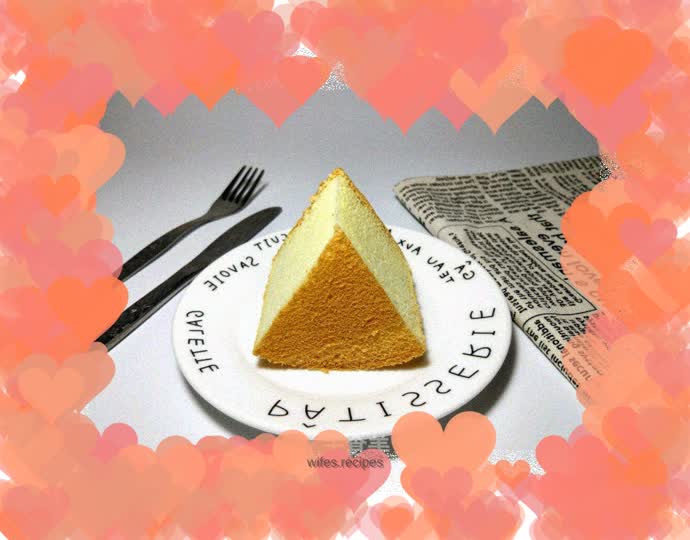
Overview
What is marked is the amount of two six-inch anode round molds. Chiffon cake is actually not difficult to make, as long as you master a few key points. In fact, if you are a novice, it is best to start with cookies/cupcakes/bread, as the success rate will be higher.
Tags
Ingredients
Steps
-
Separate the egg whites and egg yolks and put them into water-free and oil-free egg beating basins. At the same time, preheat the oven to 150 degrees for 10 minutes.

-
Add the water, fine sugar, and corn oil noted in the main ingredients to the egg yolks, and beat with a whisk until the egg yolks become larger in volume and lighter in color. The smaller the particles of grease, the more evenly distributed they are. This can be done with a hand whisk. It doesn’t matter if the eggs are refrigerated or at room temperature, as long as they are fresh.

-
Sift in the mixture of low-gluten flour and cornstarch, and stir from the bottom to a fine and sticky state. Set aside. Don't over mix to avoid gluten formation. If there are really lumps, you can sift the batter once

-
Add a little lemon juice or white vinegar to the separated egg whites, and use an electric egg beater to beat in circles at a constant speed in one direction. Egg whites are alkaline, so adding acidic lemon juice or white vinegar to neutralize them will make them easier to whip. It is better to use lemon juice, which can remove the fishy smell and improve the fragrance. It’s okay to add neither.

-
Add the fine sugar in the auxiliary ingredients in three batches (fish eye bubbles, obvious patterns, large hook state) and beat until hard foaming state. As shown in the picture, after stopping the egg beater, lift the egg beater and the egg whites will form sharp corners. This sharp corner can be short and upright, or it can be slightly taller and the top seems to be curved but not curved. Both are acceptable. If it is difficult for a novice to judge, you can make it straight and short with sharp corners to avoid insufficient whipping and defoaming in the middle.

-
Add the beaten egg white to the egg yolk liquid in three batches, and mix in a cross pattern from the bottom. After each time, add the next one until everything is mixed.

-
The state after mixing is fine and viscous, and the volume is not much different from the beaten egg white before mixing. There are no white lumps of egg white, and there is no residual egg yolk paste at the bottom of the egg beating basin. If the volume shrinks significantly after mixing, it means defoaming, which may be caused by insufficient whipping of the egg whites or over-stirring. You don’t have to go into the oven to know it’s failed.

-
Pour the prepared cake batter into the mold all at once. Do not use a spatula to scrape into the mold piece by piece to avoid introducing excess air. Bump it a few times to release air bubbles and roughly smooth the surface.

-
Place in the middle and lower racks of the preheated oven and bake at 135 degrees for about 40 minutes. The specific time and temperature should be increased as appropriate according to different ovens. Generally, I bake the eight-inch ones at 135 degrees for about 70-80 minutes until they are cooked through. The temperature of this oven is 10 degrees higher, and the fire is more urgent. You can refer to it, or use an oven thermometer to assist.

-
When finished, place it upside down on a drying net and remove from the mold after cooling. There are two ways to demould. One is to use a demoulding knife to scrape along the edge, with the bottom facing up. Second, just rub the edges with your hands. The cake structure is very elastic and can be easily released from the mold.
