Dry Pot Thousand Page Tofu
Overview
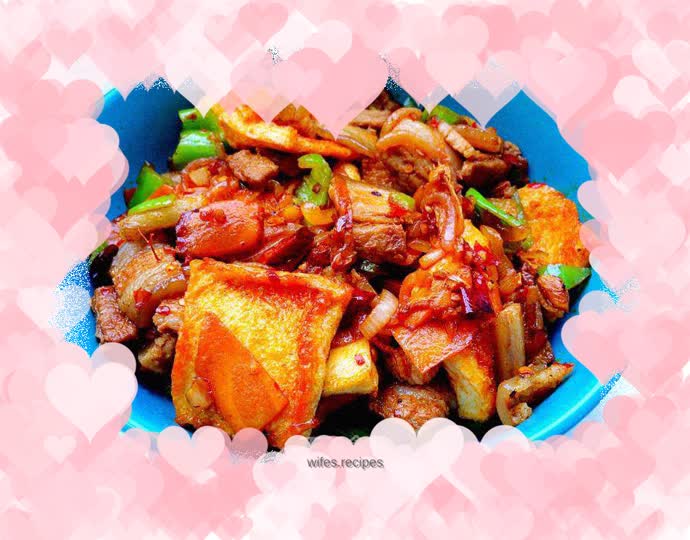
Thousand-page tofu is a new vegetarian product that is widely popular in coastal cities and northern areas of the mainland. It adopts Taiwan's latest tofu making technology and is refined with soybean flour and starch as the main ingredients. It is a new century delicacy rich in protein. It not only maintains the original tenderness of tofu, but also has a unique Q-jing and crispness. It also has super soup absorption capacity. With modern cooking skills, it can make high-quality new fashionable delicacies. Thousand-page tofu can be eaten in many ways. It can be used as a stand-alone dish, as a main ingredient, an auxiliary ingredient, or as a seasoning. It is suitable for a variety of cooking methods, such as steaming, stewing, frying, smoking, or cold dressing. Today's dry pot Qianye Tofu is a combination of Sichuan style twice-cooked pork. It is spicy and fragrant and goes very well with rice.
Tags
Ingredients
Steps
-
Take a piece of pork belly, scrape off the dirt on the surface of the pork belly, wash and set aside

-
Sit in a pot and boil water. When the water boils, add a small amount of Sichuan peppercorns, one star anise, one piece of cinnamon, a small amount of cooking wine. Add the pork belly, turn to low heat and simmer for about ten minutes. This step is the same as the twice-cooked pork recipe

-
Cook for about 8 to 10 minutes until the meat is half cooked, then remove and set aside

-
While cooking the pork belly, you can prepare the fried Chiba tofu. I only used half a box today

-
Slice the tofu and set aside. I cut it thicker, it depends on personal preference

-
Pour an appropriate amount of cooking oil into the frying pan. When the oil is hot, add the tofu and fry over low heat

-
Flip half way through and fry until both sides of the tofu are browned and set aside. Chiba tofu will swell when fried, then collapse and shrink when cooled

-
Prepare other side dishes. Peel and wash the onion, peel and wash the carrot, wash the two green peppers and set aside

-
Shred onions, slice carrots, and dice green peppers, set aside

-
Wash the dried chilies and cut into rings, peel, wash and slice the ginger, peel, wash and mince the garlic and set aside

-
Take out the cooled pork belly and slice it into slices. It doesn’t need to be as thin as twice-cooked pork, just one millimeter slice.

-
Heat the pan, add the pork belly slices, stir-fry the meat slices over low heat to release the oil, be careful not to burn the pan. If you like the meat slices a little browner and more oily, you can stir-fry them for a longer time and set aside

-
Use the oil from the pork belly, add an appropriate amount of Sichuan peppercorns, stir-fry over low heat until fragrant, remove the Sichuan peppercorns and leave the Sichuan peppercorn oil

-
Add minced garlic, ginger slices and dried chili pepper, stir until fragrant

-
Add onion, stir-fry until brown

-
Add carrots and stir-fry

-
Place the onions and carrots on one side of the pot, add a spoonful of bean paste and stir-fry the red oil

-
Add the fried Chiba tofu and stir-fry

-
Add pork belly slices and stir-fry

-
Pour in a little light soy sauce and a little sugar. Doubanjiang is relatively salty, just use less light soy sauce. To test the saltiness, I added a little salt and chicken essence. I didn’t add them today. Everyone should try to consume as little salt as possible

-
Add green peppers, stir-fry over high heat for a minute or two and serve

-
Finished product.

-
The tofu is tender and elastic, the pork belly slices are fried with rich aroma, the watercress is mixed with pepper and onion flavor, plus green pepper and carrot, it is comprehensive in nutrition, rich in taste, and goes very well with rice
